Where Collaboration Meets Capacity: What It Really Means for a School District
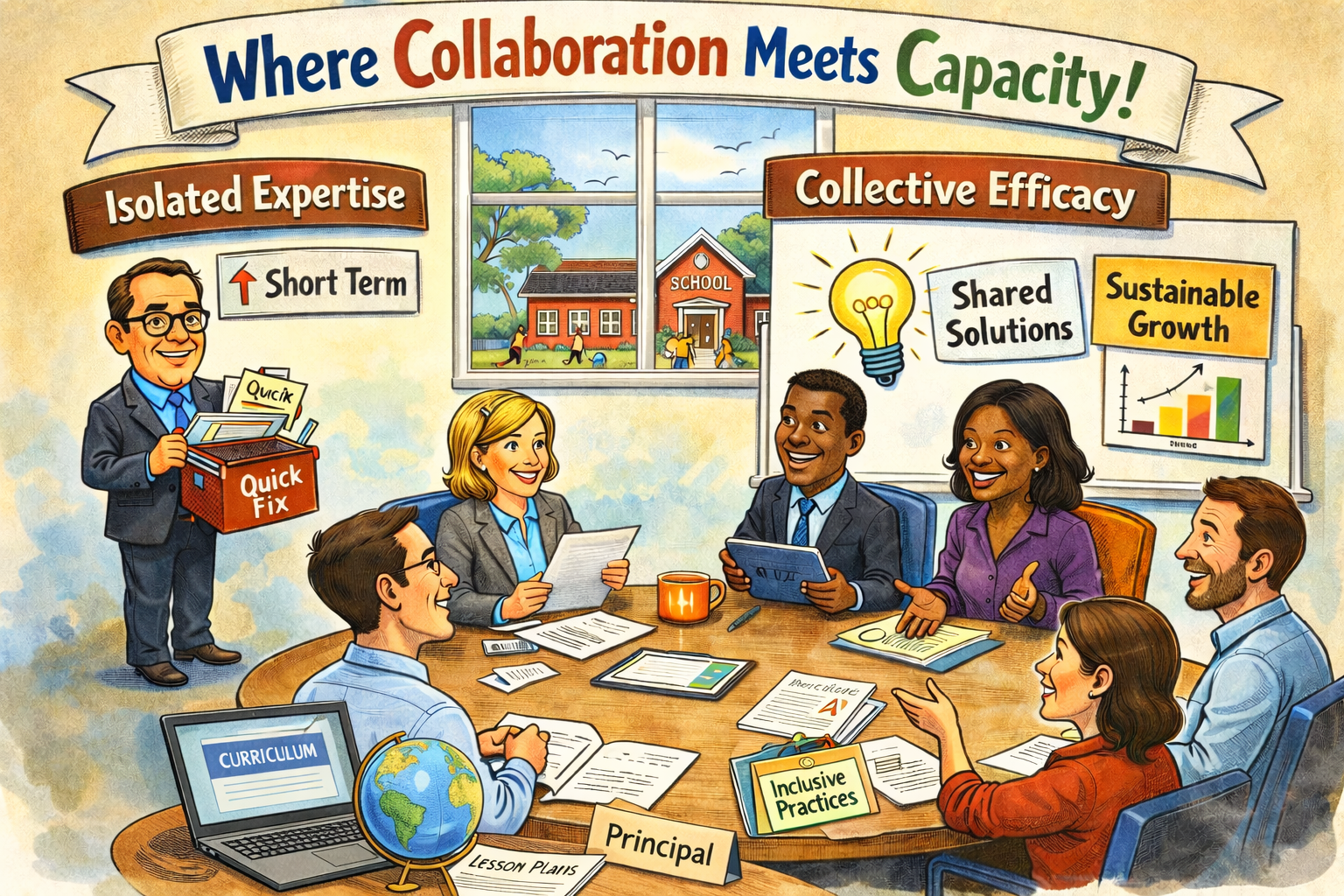
When a school district embraces the idea of “where collaboration meets capacity,” it moves beyond a simple mantra and shifts to a clear and intentional approach to leadership. For districts partnering with EmpowerEd Educational Consulting Group, LLC, this phrase represents a strategic shift: from isolated expertise to collective efficacy and from short-term fixes to sustainable growth.
But what does that actually look like in practice?
Let’s unpack it.
Collaboration Is Not Just Working Together
In many districts, collaboration is already visible. Teams meet regularly, agendas are circulated, professional learning communities convene, and committees are formed to address key initiatives. Yet true collaboration is not defined by proximity or simple participation. It is characterized by shared ownership of outcomes, structured dialogue that deepens thinking, collective problem-solving grounded in student needs, and decision-making processes that distribute leadership rather than centralize it. When a district approaches collaboration with intention, it moves beyond the mindset of “Let’s meet about this” and instead embraces “Let’s think about this together in disciplined, strategic ways.” In doing so, collaboration shifts from being an event on the calendar to becoming a lever for meaningful and sustained improvement.
Capacity Is More Than Skill-Building
Capacity is often reduced to training, as if a workshop or certification alone can transform practice. While professional development certainly plays an important role, true capacity runs much deeper. It reflects a district’s ability to consistently generate effective practice, regardless of who is present, who has recently attended training, or who holds a particular role.
Capacity is evident when leadership is clear and aligned at every level of the organization. It shows up in strong instructional expertise, in systems that support thoughtful decision-making rather than reactive problem-solving, and in financial structures that reflect and reinforce district priorities. It is sustained through intentional frameworks and processes that continue to function even as personnel or initiatives change.
Ultimately, capacity is what remains after consultants leave the room. It is the internal strength of a district, the coherence that enables leaders and teams to navigate complexity with intention instead of slipping into crisis mode.

Where the Two Intersect
The power lies at the intersection.
Collaboration without capacity becomes conversation without change.
Capacity without collaboration becomes expertise without ownership.
But when collaboration meets capacity, something shifts:
Leaders stop carrying the weight alone.
Teams move from reacting to planning.
Compliance conversations transform into improvement conversations.
Data becomes a tool for insight, not intimidation.
Instructional decisions align with shared values.
The intersection creates collective efficacy, the belief and the demonstrated ability that, together, we can improve outcomes for students.
Why This Matters
Districts today are navigating:
Increased accountability measures
Staffing instability
Funding complexity
Heightened equity expectations
The growing and complex needs of students
In this environment, isolated leadership models fail.
No single administrator, director, or superintendent can hold the full weight of instructional improvement, fiscal responsibility, compliance management, and cultural transformation.
Collaboration distributes the thinking.
Capacity ensures that thinking leads to action.
Together, they create resilience.
That intersection is where meaningful transformation begins.